
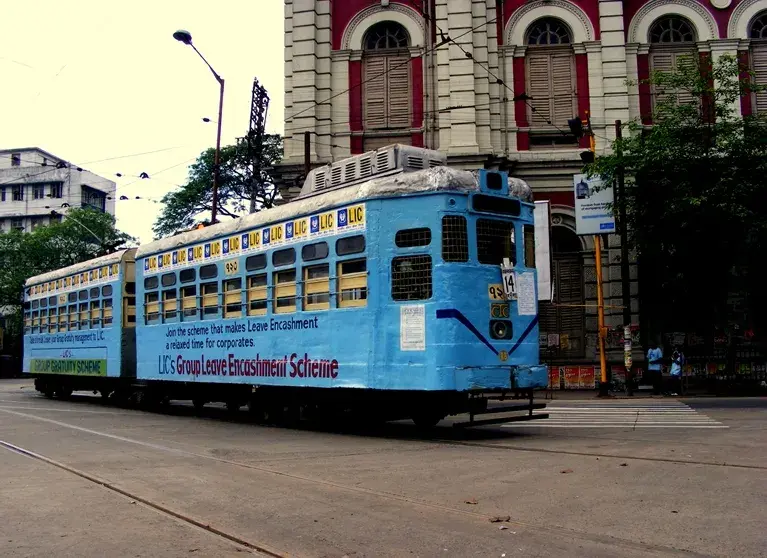
Kolkata is not a quiet city. It announces itself in layers — auto-rickshaw horns, pressure cooker whistles from open windows, the argument two floors above, the vendor below, a dhak drum from somewhere deep in the lanes. For 151 years, one sound moved through all of it differently. Not competing, not adding to the noise, but cutting clean across it: the soft, unhurried clang of a tram bell. A single note. And somehow, the city parted. Like a breeze you didn't know you needed until it arrived.
151 Years on the Rails
On February 24, 1873, the first horse-drawn tram in India made its maiden run along a four-kilometre stretch from Sealdah to Armenian Ghat. The Calcutta Tramways Company was formally registered in London in 1880, and on March 27, 1902, the first electric tramcar in Asia rolled from Esplanade to Kidderpore — a fact Kolkata carried with the quiet satisfaction of a city that knows its own worth. At its peak, the network spanned 37 routes, connecting neighbourhoods across the whole length and breadth of the city.
A Room That Moved
The tram moved at roughly 12 kilometres an hour. This, in a city that never stopped accelerating around it, turned out to be its most radical quality. Board at Esplanade on a weekday morning and something shifted. The city stopped being a thing to get through and became a thing to inhabit — a man ironing shirts on a pavement, a cat asleep across the full width of a chai stall's counter, a building peeling back three decades of paint in a single flaking wall.
The tram didn't need an algorithm for community. It just needed bench seats facing each other.
The carriage was a room that moved. Wooden bench seats worn smooth by a century of passengers. Windows you could actually lean out of and feel the morning air on your face. Strangers sitting close enough to share a newspaper. There was a social warmth to this forced proximity — a quality of accidental community — that the sealed, air-conditioned cab has spent two decades trying and failing to reproduce.
The Green Argument Nobody Heard
For Bengalis of a certain generation, the tram is woven into the fabric of personal history — the vehicle you took to Presidency College, to your first job interview in a borrowed tie, to the coffee house on College Street for a conversation that lasted four hours. Satyajit Ray understood this instinctively. In Mahanagar, the film opens on the sparks from a tram cable — the city's grind rendered in a single image.
There is also an argument the tram made quietly, without anyone listening: it was among the most environmentally responsible forms of urban transit ever conceived. Electric cables, zero street-level emissions, dozens of passengers in the footprint of two cars — the extraordinary efficiency of a steel wheel on a steel rail. At a time when cities worldwide are spending billions retrofitting clean transit systems, Kolkata had been running one for over a century. The tram was a green solution so old it had been mistaken for an inconvenience.
In September 2024, the West Bengal government announced the discontinuation of tram services across the city. Traffic congestion had won the argument it had been making since the 1970s. One hundred and fifty-one years after that first journey from Sealdah to Armenian Ghat, the network fell silent — all except for a short heritage stretch between Maidan and Esplanade. The last regular bell rang not with ceremony, but with the quiet resignation of something that had simply been there too long to merit a proper goodbye.
See the streets the tram once ran on a guided walk through North Kolkata — the lanes, the ghats, and the river.
Explore North Kolkata →