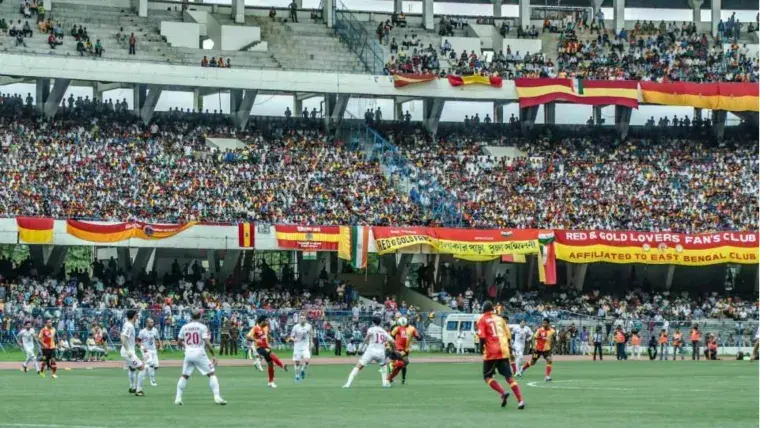
The Maidan on derby morning smells of damp grass and something older — tobacco and tension, the particular electricity of a city that has quietly taken sides. It is barely seven in the morning and already the tea stalls along Chowringhee are doing serious business, each proprietor's allegiance announced by a strip of green-and-maroon or red-and-gold wound around a tea urn or pinned above the kerosene flame. By the time the sun clears the Victoria Memorial, Kolkata will have divided itself — not along lines of wealth or religion but along something older, more geological: the question of where you, or your grandfather, are from.
How Two Clubs Were Born from Fury
Mohun Bagan Athletic Club was founded on 15 August 1889 — a date that would acquire retrospective poetry when India gained independence fifty-eight years later on the same day. The club was a product of prosperous North Calcutta, an institution of the Ghotis: people native to western Bengal, rooted here for generations. East Bengal came into existence in 1920 through an act of fury. A club official dropped a midfielder not for form, but because he was a Bangal — a migrant from the eastern banks. The founding president walked out that day and named the new club, without ambiguity, East Bengal. A different, longer match had just begun.
The 1911 IFA Shield: A First Act of Defiance
Barefoot players, ten of the eleven without boots, defeated a British military side in full kit. Kolkata erupted in a way that defied description.
Reuters correspondent, London cable, 1911
When Mohun Bagan defeated the East Yorkshire Regiment in the 1911 IFA Shield final — barefoot players facing a British military side in full kit — the city did not merely celebrate a football result. Special trains brought supporters from Dhaka, Assam, and Patna. Kites in green-and-maroon filled the Maidan sky. That 2-1 victory was, to a colonised city still two decades from independence, evidence that the gap between ruler and ruled could be crossed on a football pitch. The Immortal XI had given the city its first collective act of defiance.
Partition and the Weight of Belonging
The 1947 partition made everything more acute. The mass migration of Bangals into West Bengal swelled East Bengal's fanbase with a grief that had nowhere else to go. To support the Red and Gold was to assert, in the language of a game, that you belonged here now. This is why, when a stampede during a Derby at Eden Gardens in 1980 killed sixteen people, the day is now observed as Football Lovers' Day across Bengal — an acknowledgement of how completely football had merged with identity.
Both clubs now compete in the Indian Super League — Mohun Bagan rebranded as Mohun Bagan Super Giant, East Bengal operating under their own name. The core of the Derby — the noise, the fish markets, the flags, the city's peculiar seasonal tension — has survived every structural change the game has imposed on it.
What is remarkable about this rivalry is how little it requires explanation within the city. The Boro Match is not a sporting event that the city organises around — it is an event that organised the city. After more than a hundred years and over four hundred meetings on the pitch, the two clubs remain less than five hundred metres apart in the Maidan. In Kolkata, proximity has never meant peace.
The Maidan, the Victoria Memorial, the city that made this rivalry — see it on a guided day in Kolkata.
Explore the City →