
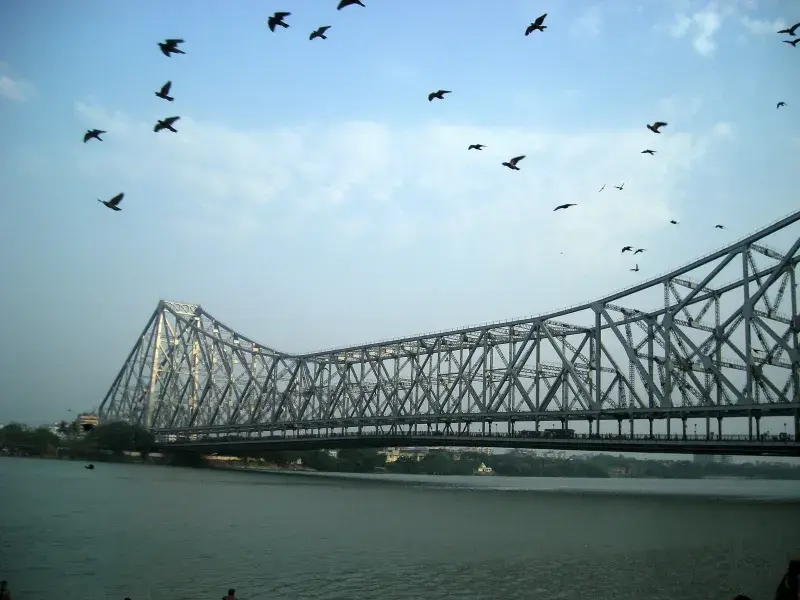
By 5:10 in the morning, the first baskets of marigold arrive under the bridge. A porter in a faded blue shirt balances two sacks on his shoulders, walking past rows of flowers still wet from the night's journey. Above him, the steel grid of Howrah Bridge begins to catch the light.
A Bridge Built Without Nuts and Bolts
When the bridge opened in 1943, it wasn't just another crossing over the Hooghly. It was a response to wartime pressure, rising traffic, and a growing city that had already outgrown its earlier pontoon bridge. Built as a cantilever structure, the Howrah Bridge does something unusual — it holds itself up without traditional nuts and bolts, relying instead on riveted steel. The design came from the British firm Rendel, Palmer and Tritton, but much of the steel was supplied by Tata Steel, tying it closely to Indian industry even under colonial rule.
At the time, it was one of the longest cantilever bridges in the world. Today, it is less about records and more about repetition — the daily act of crossing that has turned it into something closer to routine than spectacle. The engineering fades into the background, even though it quietly supports one of the densest flows of people in the country.
Underneath: The Flower Market That Wakes Before the City
Directly beneath the bridge, the Mullick Ghat Flower Market begins long before sunrise. Trucks arrive from districts like Nadia and Hooghly, carrying jasmine, hibiscus, and tuberose. By the time the first local trains reach Howrah Station, the market is already in full motion. The air is thick with the smell of marigold and damp rope, and transactions happen quickly — bundles weighed, prices negotiated, cash exchanged.
The bridge carries the city forward, but the market below keeps it grounded.
Most people who cross the bridge never come down here. From above, it's just a blur of orange and white. But on the ground, it's a tightly coordinated system that feeds temples, weddings, and roadside shrines across Kolkata. The bridge and the market exist in layers — one visible from afar, the other understood only if you step into it.
Between Howrah and Kolkata
Technically, the bridge connects two cities — Howrah on one side and Kolkata on the other. But for most people, that distinction disappears in the act of crossing. Office workers, students, vendors, and porters move in a steady stream, rarely pausing. The bridge is less a boundary and more a corridor, compressing distance into a few minutes of movement.
It's this constant movement that gives the bridge its identity. Not the steel, not the scale, but the people who use it every day. The same man who carried flowers at dawn might cross again in the afternoon, empty-handed this time. The rhythm repeats, largely unnoticed, except by those who depend on it.
A Backdrop That Means Something Different to Everyone
In recent years, the bridge has also become a popular backdrop for pre-wedding shoots. Couples arrive early to catch the soft light, posing against the geometric lines of the steel structure. For them, the bridge becomes something symbolic — permanence, connection, a shared future. Photographers frame it carefully, often cropping out the crowds below.
It's a different way of seeing the same structure. For daily commuters, the bridge is functional. For photographers, it becomes aesthetic. For the workers underneath, it's simply overhead — part of the environment, like the sky. Each perspective is valid, but none tells the whole story on its own.
The flower market and Howrah Bridge at dawn are the opening of our private North Kolkata day — every morning, every group.
See the North Kolkata Tour →