
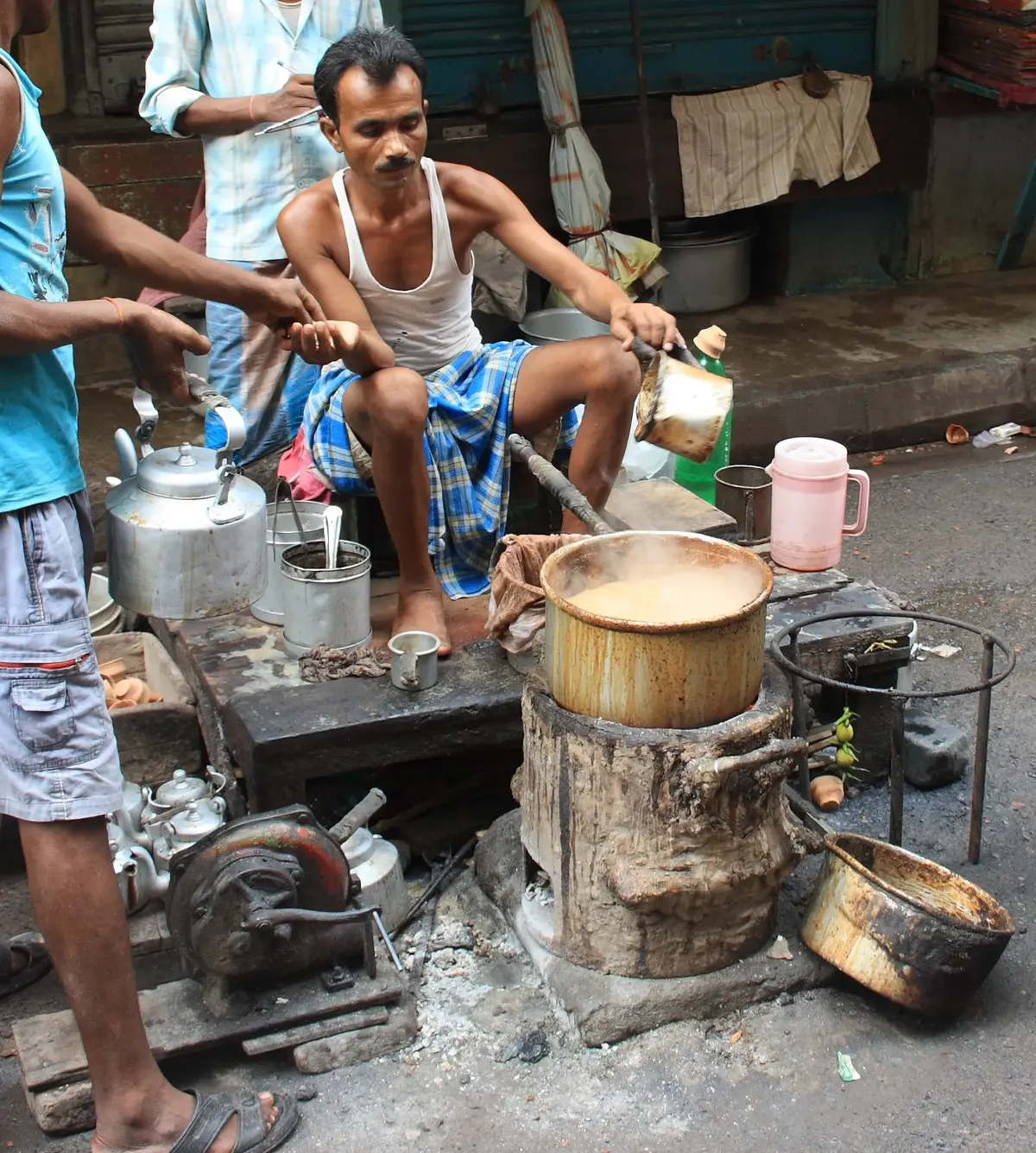
The flame under the aluminium pot is barely visible in the morning light. A man in a lungi tears open a sachet of tea powder — the same brand his father used — and tips it into milk that is already trembling near the boil. Sugar goes in without measuring. Around the narrow counter, four men stand close enough to touch, not talking yet, waiting. In Kolkata, cha is not what you drink while you wait for your life to begin. It is where your life is actually lived.
A Colonial Habit That Outlasted the Empire
Tea has grown in the hills above Bengal since the 1840s, when British administrators first cultivated it in Darjeeling — partly as an imperial hedge against dependence on Chinese supply, partly as a commercial enterprise built on cheap local labour. For decades, the finest leaves left on trains bound for auction houses in London. Indians, by and large, did not drink tea. That changed through deliberate design: the Indian Tea Association's campaign to seed the habit became, within a generation, the emotional grammar of an entire city.
The Bhaanr
Order at a Kolkata cha er dokan and the transaction takes under a minute. The cup placed before you is a bhaanr, a small unglazed terracotta vessel that smells faintly of earth and fire. The tea inside is thick, intensely sweet, a deep caramel-brown from milk and CTC powder boiled together until they are inseparable. It burns the fingers pleasantly. You stand, hold the bhaanr in two palms, and let the warmth move up your arms while the street performs around you. The cup costs between five and ten rupees.
Adda requires a surface to lean on, a mild stimulant, and the tacit agreement that nothing productive will be accomplished. The cha er thek is its natural habitat.
Bengalis have a word — adda — that has no precise translation in any language that did not grow up beside the Hooghly. It describes a mode of conversation that is neither debate nor gossip nor storytelling, but some combustible mixture of all three, conducted without agenda and without end. Rabindranath Tagore wrote warmly of the culture of leisurely discourse that Bengali intellectual life depended upon. Tea filled that role and never relinquished it.
Democracy in a Clay Cup
There is a particular irony, which Kolkatans tend to appreciate rather than resent, in the fact that the beverage most central to Bengali identity was introduced as a commercial product by the people who were simultaneously governing and extracting from them. At a cha er thek, social hierarchies compress in ways they rarely do elsewhere in the city. The lawyer and the auto-rickshaw driver stand side by side at the same counter, paying the same price, making the same small ritual.
The Kolkata tea stall is not vanishing — if anything, new ones open weekly — but the tea itself has quietly changed. The CTC method of processing became dominant by the mid-twentieth century. Meanwhile, international café chains have arrived in South Kolkata, offering pour-overs to a younger, moneyed clientele. They are busy. But so is every cha er thek on every lane in the city, at every hour of every day.
Kolkata does not need a café. It never did. The thek — chipped counter, bare bulb, aluminium pot, four men and one argument and a bhaanr that warms both palms — has always been enough, because the point was never the tea. The point was the excuse to stop, to stand beside another person, to be briefly still in a city that does not otherwise permit stillness.
Start your morning with cha and kochuri in a North Kolkata lane — it's how our guided day begins.
See the North Kolkata Tour →