
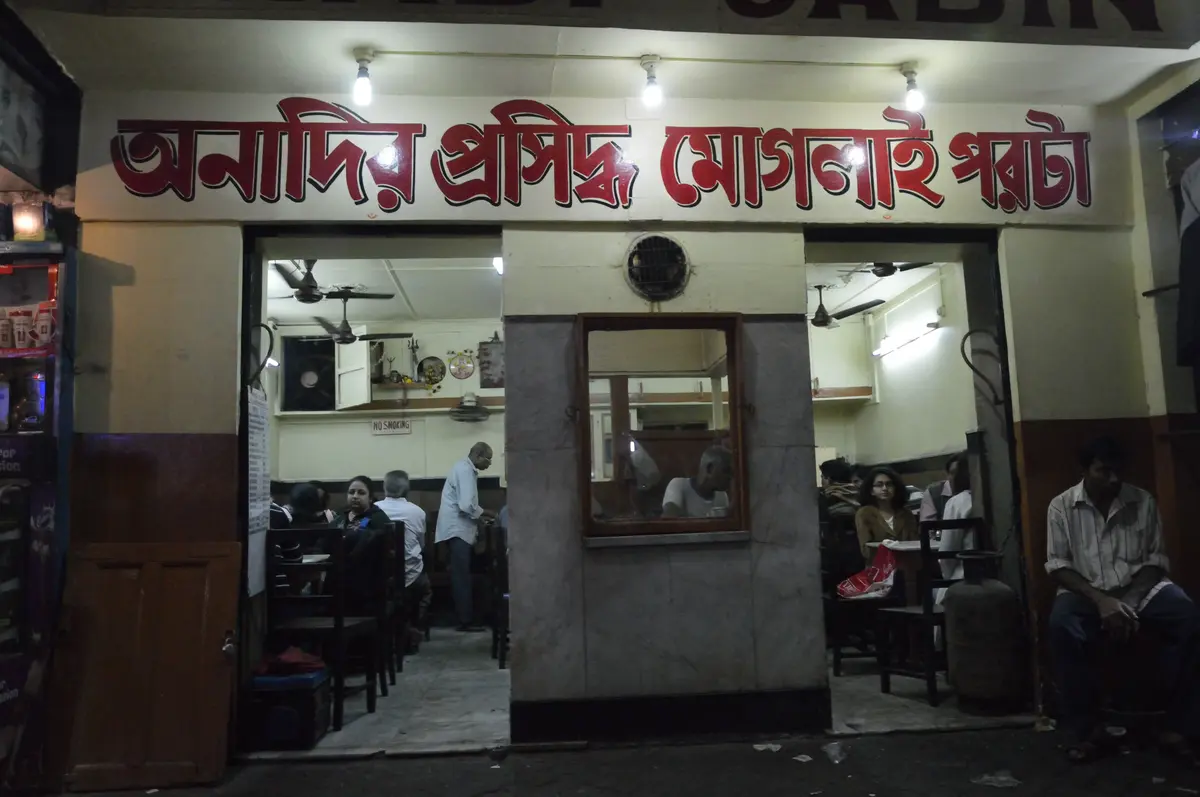
The door is barely wider than your shoulders. Inside, the light has been the same shade of amber for decades — low-watt bulbs strung above wooden partitions that divide the room into narrow stalls, each just wide enough for two people to sit facing each other with knees almost touching. A man in a checked lungi moves between the booths without looking up. Outside, College Street churns. In here, no one checks their phone. The world reduced to a wooden booth, a hot plate, and the low murmur of someone else's conversation on the other side of the partition.
Born from a Colonial Encounter
Kolkata's cabin restaurants — known simply as 'cabins' — took shape in the late nineteenth and early twentieth centuries, as British Calcutta reconfigured both the city's architecture and its appetite. They emerged primarily around the city's intellectual quarters — College Street, Shyambazar, Jorasanko — and found their natural clientele among the Bengali bhadralok, the educated middle class navigating a complicated relationship with their colonial rulers and, increasingly, their colonial menus. The cabin was where that negotiation happened in private, over a plate.
The Menu Has Not Changed
Ordering requires no printed menu. Most surviving cabins have served the same seven or eight dishes for generations. You ask for a fish fry — thick slabs of bhetki, crumbed and fried to a dark golden crust, served with kasundi, the sharp Bengali mustard sauce that no imported bottle has ever approximated. What is notable, for establishments so unadorned and unhurried, is that the food needs nothing else around it. Nothing here has been stored in a refrigerator; every piece of fish, every cutlet, is prepared that day.
The booth, the cold tea, and the low ceiling together constitute a kind of home.
Anjan Dutta, Das Kebin
The cabin was never only about eating. Bengali students came here to argue about politics and poetry at a volume just above a whisper. Couples, in a city that offered few private corners, slipped into the booths for an hour of relative anonymity. Senior men still arrive for adda — the Kolkata practice of extended conversation that treats time as something to be inhabited rather than spent.
The Kobiraji Cutlet: A Linguistic Record
The cabin's signature dish is a kind of etymology. The kobiraji cutlet — a minced fish or meat patty enclosed in a trembling net of beaten egg, fried until the egg sets into something resembling lace — takes its name, local culinary historians argue, from the English word 'coverage.' A British cooking term, passed through a Bengali kitchen and a Bengali tongue, returned as something the British themselves would not recognise. Colonialism, in Kolkata's cabins, was absorbed, altered, and served back on a steel plate.
Today, the number of functioning cabin restaurants can be counted without much effort. Many closed during the decades of urban expansion. A handful persist — a few around College Street, others near Shyambazar. What is striking is that they are not quiet. Seats fill early. The fish fry sells out before noon on weekends. The businesses that remain are surviving on exactly what they always offered: food made that morning, and the specific comfort of a room designed to make two people feel briefly alone.
The cabin is not a monument. It does not trade in nostalgia or arrange itself for photographs. It opens in the morning, cooks what it has, closes when it runs out, and does the same thing the next day. That refusal may be precisely why it has outlasted almost everything around it.
The cabin cutlet, the kasundi, the wooden booth — taste them on a private food-first tour of North Kolkata.
Book the Curated Food Tour →