
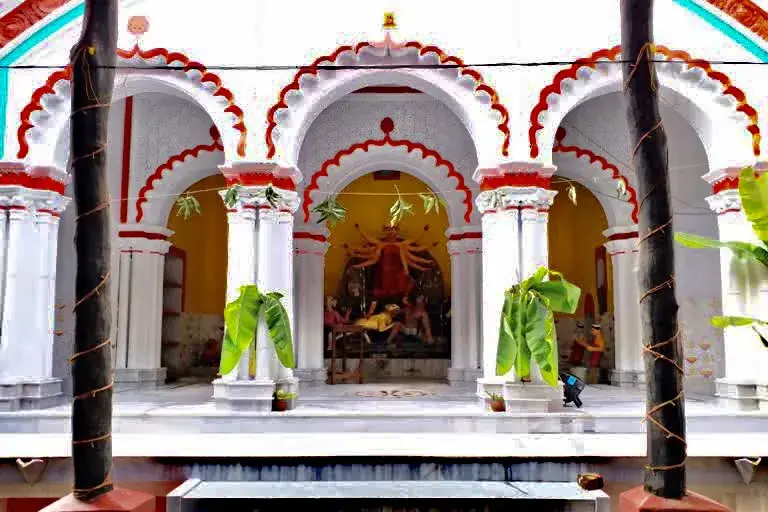
Push open a gate on almost any lane in North Kolkata and you may find yourself in a different century. The street behind you — autorickshaws, chai stalls, a vendor of green coconuts — disappears. In front of you is a courtyard. Columns rise two storeys, improbably white against the grime of the facade they support. Plaster medallions, some crumbling at the edges, trace the outline of what was once a ceiling fresco. This is a Bonedi Bari — the ancestral seat of one of Kolkata's old zamindar families — and it contains, in its proportions and its silences, the biography of a city.
What Bonedi Means
The word bonedi carries a social weight that does not translate cleanly. It means, roughly, aristocratic — but an aristocracy of a particular kind: Bengali landowning families whose authority pre-dated the British, deriving from Mughal-era revenue grants or older still. Families like the Sabarna Roy Choudhurys, the Debs of Shobhabazar, or the Mullicks of Pathuriaghata built not just houses but entire parallel worlds, enclosed behind high walls and gate-posts that announced, before you even knocked, that this was a household of consequence.
The Architecture of Ambition
The buildings themselves are among the strangest and most compelling in India. Built across the late eighteenth and nineteenth centuries, they drew from wherever the money pointed: Corinthian capitals, Doric porticos, Venetian floor tiles, Belgian stained glass, Italian marble shipped up the Hooghly — all assembled by Bengali craftsmen who wove into these European forms the carved wooden screens, terracotta friezes, and inner-courtyard logic of the Bengal they actually knew. At the Marble Palace in Muktaram Babu Street, built around 1835, Corinthian columns flank a courtyard housing European oil paintings alongside Belgian crystal chandeliers — all still standing, still inhabited by Mullick descendants.
The zamindar's courtyard was the crucible for everything the nineteenth century was about to become.
What happened inside these houses mattered as much as the stone. The baithakkhana, the formal receiving room, functioned as a salon where Hindustani classical musicians, poets, playwrights, and reformers gathered under the same roof. It was in houses like these that the Bengal Renaissance took shape: Derozio's Young Bengal movement passed through them, the Brahmo Samaj held its early meetings in drawing rooms that smelled of attar and teak polish.
Durga Puja as Power
Once a year, the private became deliberately public. The Bonedi Bari Durga Puja was never purely a religious occasion — it was the grandest expression of a family's social position, and to host one with insufficient splendour was, in the logic of the time, a kind of failure. Craftsmen from Kumartuli worked for months on idols commissioned for a particular household. The lanes outside the Shobhabazar Rajbari, whose puja dates to the mid-eighteenth century, would fill with people who came not to pray but to witness.
Most of these houses are now in a condition that requires a certain tolerance for melancholy. Partition among heirs, court disputes spanning decades, and the sheer cost of maintaining structures built for permanent wealth have left whole wings sealed, staircases roped off, and stucco falling in rooms that no longer have a function. Some families resist classification as heritage sites entirely — to be listed, they feel, is to become a monument to your own absence.
The city has grown entirely around these houses now. Glass towers rise three blocks away; the lane outside fills with delivery motorcycles at noon. But step inside the gate and the proportions change. The courtyard is still the courtyard. Whatever was built here left an impression in the material that outlasted the confidence that made it. Kolkata is still, in many places, living inside that impression.
Walk the lanes of North Kolkata's Bonedi Baris — past gates, courtyards and crumbling grandeur — with a guide who knows their stories.
Book the Heritage Tour →